






Commander’s Premise
Five-color decks usually spend their first few turns apologizing to their own mana base. Most of them play a clunky game of fixing, then finally cast a pile of powerful but unrelated cards once all the colors line up. This build takes that familiar shape and gives it a clear classroom theme, so every spell you cast has a job to do in the same curriculum.
Codie, Ravenous Codex is a three-mana artifact creature that changes how the prepare mechanic works for you. First, whenever you cast a prepared spell, it copies that spell, and you may choose new targets for the copy. Second, for one mana of each of the five colors plus tapping it, each creature you control becomes prepared, though only creatures that actually have a prepare spell can take advantage of this.
Read that second ability slowly. It turns a board full of creatures into a stack of spells waiting to be cast, and each of those spells arrives twice. A modest card-draw spell becomes a pair of draws, a small recovery effect becomes a pair of returns, and a small lifegain spell becomes a meaningful buffer against an aggressive table.
The deck leans on this loop while staying friendly to the lowest power bracket. Campuses and charms smooth out the colors, creatures with built-in second spells provide the raw material, and Codie, Ravenous Codex multiplies the value without ever asking you to assemble a combo. It is a deck for players who enjoy watching a board of students graduate with honors, one copied spell at a time.
How it Compares to Others?
Our deck sits in a distinct corner of the five-color world: a budget, low-power value deck built around a college theme and a repeatable spell-copying plan. That puts it close to some archetypes and far from others.
Compared with the archetype in Budget Five-Color Deck Building And You, the overlap is obvious. Both aim to make an affordable five-color deck function, and both rely on consistent fixing to reach every color without costly lands. Both accept that budget mana means some tapped lands and slower starts. The difference lies in what happens after the mana works. That article focuses on building a dependable foundation and treats the win condition as secondary, while this deck has a defined payoff: prepared creatures, copied spells, and steady incremental advantage. Our deck also fixes through its own themed campuses and charms instead of a general toolbox of ramp and rocks.
The archetype in The Unique Jodah, The Unifier Decks Variety Hour is a themed five-color midrange build that lets a repeating trigger do most of the work and aims to control the game once its centerpiece is established. That mirrors our approach, since both are themed, value-driven, and built to avoid feeling like generic good stuff. The contrast is power and pacing. That archetype is described as strong and capable of controlling the board, with selective sweepers to protect its own team. Ours is intentionally gentler, a Bracket 1 deck that wins slowly through wide combat rather than dominating the table. Both share the same weakness, though: if the colors do not line up, the plan stalls.
Core Gameplay
The deck plays like a seminar that keeps assigning extra credit. Your creatures arrive as ordinary bodies, but each one also carries a second spell, and Codie, Ravenous Codex is the teacher who makes sure every one of those spells gets cast twice. Your job is to develop the board, find all five colors, and then start cashing in prepared spells while the table underestimates a pile of small creatures.
Because this is a Bracket 1 build, nobody at the table expects a fast kill, and you should lean into that. Play to the board, keep your life total healthy, and accept that the game rewards patience. Tapped campuses are a feature here, not a flaw, since the early turns are meant to be spent smoothing mana rather than racing.
A strong opening hand holds two or three lands (at least one campus), a cheap creature that fixes or draws, and a mana rock or artifact for the turns that follow. Mulligan hands that are all expensive creatures with no way to reach a second color. You can afford a slow start, but you cannot afford a stalled one.
Early Game
Start by tucking a campus onto the battlefield on turn one. Lorehold Campus and Quandrix Campus both enter tapped and tap for two colors each, so playing them on the earliest turns costs you almost nothing. Later, when mana is plentiful, their ability to scry for four mana gives you a quiet way to sink spare resources into a better draw.
On turn two, a creature that fixes or draws is the best use of your mana.
Turn three is where the deck starts to show its theme.
Slot Diary of Dreams into any gap you find. It costs two mana, collects a page counter whenever you cast an instant or sorcery, and eventually turns into a cheap card-draw ability. Since your prepared spells and charms all count, it fills up faster than you might expect.
Hold back your more expensive plays until you can name your colors. A hand full of one-color cards is not a problem if you have the campuses to support it. Sequence the lands first, the fixing creatures second, and the payoffs last.
Mid Game
Once you reach three mana, the plan comes together. Cast Codie, Ravenous Codex as soon as the board can support it, ideally with at least two creatures already carrying prepare spells. Its activated ability needs one mana of each color plus a tap, so the real milestone is having all five colors available, not simply reaching a particular land count.
When that moment arrives, make your creatures prepared and start casting.
Do not forget about the creatures that make the table less comfortable. Deluge Virtuoso is a three-mana Human Wizard that taps and stuns a creature an opponent controls when it enters, buying you a full turn cycle against the biggest threat. It also grows whenever you cast an instant or sorcery, so a prepared spell cast alongside it can swing combat in your favor.
Ral Zarek, Guest Lecturer adds another angle at three mana. Use the plus ability to surveil while building loyalty, and save the minus ability that returns a small creature from your graveyard for when a key piece has fallen. That recursion pairs well with creatures that have enter effects.
Meanwhile,
End Game
By the late turns, the table should be full of creatures and your hand should be thinner than anyone else’s. This is the stage where you convert value into damage. Keep Codie, Ravenous Codex protected, because the commander is the lever for everything else, and recast it if the table removes it.
Mica, Reader of Ruins is the finishing support piece worth adding. It has ward that costs three life, which makes opponents think twice before targeting it, and whenever you cast an instant or sorcery you may sacrifice an artifact to copy that spell. In a deck with a few artifacts, that gives you one more way to double up. Biblioplex Tomekeeper works as a backup plan, because when it enters it can make a creature prepared, giving you a way to enable prepared spells even if the commander is stuck in the command zone.
For a concrete finish, look for a turn when you have five colors, a wide board, and two spare mana. Activate Codie, Ravenous Codex, cast a prepared spell such as the one on
Prismari Charm offers a different kind of closer. Use it to surveil and draw when you need to refill, to ping small creatures, or to return a problem permanent to its owner’s hand before combat.
Attack with everything that can profit from it, keep a charm open for a trick, and let the copied spells do the heavy lifting. The win is not flashy, but it is steady, and in Bracket 1 that is exactly the point.
Power Analysis and Decklist
Codex of Strixhaven’s Five Ways sits at Bracket 1, the most casual tier of the Commander bracket system. At a Bracket 1 table, expect games that run long, favor theme over efficiency, and reward players who enjoy watching a plan unfold rather than racing to close it out. The deck carries zero Game Changers, and its total price comes to about $55.12, which keeps a five-color build accessible for almost any budget.
Pilots should know the tradeoff up front. Without tutors, fast mana, or a combo finish, the deck depends on landing its commander and lining up all five colors before the payoffs begin. Early removal on the commander, or a stumble on fixing, can leave you holding a hand of small creatures and unused second spells. That is an honest cost of playing a themed budget list, and it is the reason a backup like Biblioplex Tomekeeper earns its slot.
The decklist breaks down as follows: one planeswalker, a creature suite built around prepare spells, five two-mana charms, two artifacts for card flow, and a ring of campuses to hold the mana together. The commander is Codie, Ravenous Codex, and the full list matches the card categories covered in the sections below.

Planeswalkers (1)
Creatures (37)
Instants (10)
Enchantments (10)
Lands (38)
101 Cards
$53.21
Deep Analysis
The intent of this build is simple: turn a themed, low-cost pile of Strixhaven cards into a coherent five-color value deck that never needs a combo to feel satisfying. Every choice supports the same loop of fixing, developing, preparing, and copying.
Consider the mana first. Five campuses provide dual-color access with a built-in scry option for the late game, and five charms give each college pair a flexible instant that can be cast cheaply. That spread matters because the commander’s activation asks for every color at once. A deck that struggles to find that mana never gets to use its best ability, so a large share of the list exists purely to make it possible.
Next, look at how the spells interact with the creatures. Cards such as Exhibition Tidecaller and Expressive Firedancer reward you for casting instants and sorceries, and the charms provide a steady stream of those triggers. Meanwhile, Flickering Hound adds a quieter layer of value by blinking another creature whenever you cast a creature spell, which can reset enter effects on bodies that have already done their job.
Resource flow comes from a small set of artifacts. Tablet of Discovery helps with early mana and can turn a milled card into an immediate play, while Diary of Dreams slowly becomes a cheap draw outlet as you cast spells. Together they keep the hand stocked without pushing the deck above its intended power level.
The recovery and support suite rounds things out.
Where does the deck lose? It struggles against fast aggression, heavy land destruction, and repeated removal aimed at the commander. It also gives up some speed compared with more focused decks. What it gains in return is a distinctive identity and a plan that plays out visibly, turn after turn, with each copied spell reminding the table why the commander is at the center of the curriculum.
Planeswalkers
Planeswalkers in this deck act as flexible support pieces rather than finishers. They smooth draws, recover fallen creatures, and give a Bracket 1 table something to contest besides the commander.
Utility Planeswalkers
This lone subcategory covers a single card that digs for answers and rebuilds the board when a key piece falls.
Costing three mana, Ral Zarek, Guest Lecturer serves as both a card-selection tool and a recursion outlet, using surveil to polish your draws and a graveyard return to bring back a cheap creature that already carries a useful enter effect.

Creatures
Creatures are the heart of the curriculum. Each one is a body first and a second spell later, which is exactly the raw material that Codie, Ravenous Codex needs to turn small plays into doubled value.
Card Advantage and Value
These creatures refill your hand, find lands, and generate the incremental edge that wins long games at a casual table.
Operating as a spell-slinging draw piece, Campus Composer gives you a body with a second half that helps you keep pace with the current board state. Meanwhile, Lluwen, Exchange Student brings a second spell that adds a little pest and can be prepared on demand by exiling a card from your graveyard, and Jadzi, Steward of Fate and Kirol, History Buff each offer a prepared spell that wants to be copied by your commander. Quietly useful, Exhibition Tidecaller is a one-mana Djinn Wizard that mills a player whenever you cast an instant or sorcery, which can fuel graveyard plans or pressure an opposing library.


Combat and Pressure
When the board is full and the table is relaxed, these creatures turn spare spells into damage.
Entering with haste and ward, Colorstorm Stallion threatens to copy itself when a large enough spell is cast. Two mana buys Expressive Firedancer, a Human Sorcerer that grows with each instant or sorcery and can gain double strike on a big spell. Then Elite Interceptor and Adventurous Eater add further attackers whose second spells keep combat favorable.


Support and Utility
This group keeps the plan resilient, offering recovery, life buffers, and a way to enable prepared spells without the commander.
Appearing as a four-mana artifact creature, Biblioplex Tomekeeper can make a creature prepared when it enters, providing a backup plan if the commander is stuck. Heartwood Crafter and Infirmary Healer stabilize the table either by ramping you or gaining some life, while Sanar, Unfinished Genius adds another source of value to the same board by tutoring any of the charms we have on the deck.


Instants
Instants give the deck its interaction and its flexibility. Each one is cheap enough to hold up while developing, and each one counts as a spell that feeds the triggers elsewhere in the list.
Flexible Charms
Five two-mana charms, one for each college pair, supply answers, tricks, and a late-game drain. Every one of them offers three modes, so a single card rarely sits dead in hand.
Rounding out the finishing suite, Silverquill Charm can exile a creature with power two or less, add two +1/+1 counters to a creature, or drain each opponent for three. Quandrix Charm is more situational, since it can counter a spell unless its controller pays two, destroy an enchantment, or set a creature’s base power and toughness to 5/5 for a turn.
Digging and tempo come from Prismari Charm, which surveils two and draws, pings one or two targets for a single damage, or bounces a nonland permanent. A graveyard-focused option, Lorehold Charm, forces an opponent to sacrifice a nontoken artifact, returns a cheap artifact or creature from your graveyard to the battlefield, or pumps your team with trample. Then there is Witherbloom Charm, which lets you sacrifice a permanent to draw two cards, gain five life, or destroy a nonland permanent with low mana value.


Artifacts
Artifacts in this list stay modest and focus on keeping your hand full. They do not push the deck past its casual power level, but they quietly reward the same instants and sorceries the rest of the list wants to cast.
Card Advantage
Both artifacts here turn spells into extra resources, one slowly and one immediately.
Starting as a two-mana Book, Diary of Dreams gathers a page counter whenever you cast an instant or sorcery, and each counter makes its draw ability cheaper to activate. Since charms and copied prepared spells all count, the cost can drop surprisingly fast over a long game.
As a three-mana rock, Tablet of Discovery mills a card when it enters and lets you play that card this turn, which can turn a plain land drop or a cheap spell into a free bonus. It also taps for red mana, with extra mana available only for instants and sorceries, so it helps both ramp and spell-casting. Note that it only produces red, so it does not solve your fixing on its own.


Lands
Lands are the backbone of any five-color deck, and in this list they carry more responsibility than usual. Every land here exists to answer one question: can you reach all five colors before the table settles into its rhythm? The answer comes from a ring of themed dual lands that also give you something to do with spare mana late in the game.
Fixing Campuses
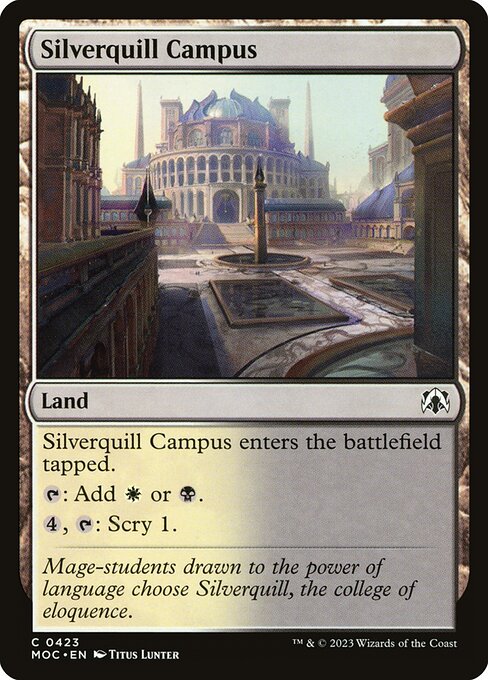
Five campuses, one for each college pair, handle the bulk of the color fixing. Each enters tapped, taps for either of its two colors, and carries a late-game scry ability, so none of them ever feels like a dead draw. Together they cover every color in the deck with a clean, budget-friendly spread.
Pairing white and black, Silverquill Campus is the natural home for the colors that power the drain and recursion effects, and it helps make sure those spells are castable when the moment comes. Black and green meet in Witherbloom Campus, which supports the recovery and lifegain side of the plan while also keeping the swampy half of the mana honest.
Green and blue come together on Quandrix Campus, a land worth playing early since your opening turns are meant for smoothing mana, not racing. Likewise, Prismari Campus links blue with red, giving the spell-focused creatures a stable footing. Rounding out the ring, Lorehold Campus ties red to white, completing the circle so that every color has at least two ways to reach the battlefield.
Because each campus enters tapped, sequencing matters. Lead with them on turns where you have no better play, and save your untapped sources for turns when you need to cast a creature right away. That discipline costs you a little tempo, but it pays you back in reliability, which is the real currency of a five-color list.
The late-game scry ability deserves a mention as well. Once the board is developed and mana piles up, paying four mana and tapping a campus lets you look at the top card of your library and decide whether to keep it. It is a modest effect, yet in a long Bracket 1 game it quietly smooths draws and finds the missing color. Treat these lands as the foundation of the curriculum: unglamorous, essential, and the reason every other lesson gets taught.


Closing Words
Codie, Ravenous Codex takes a humble stack of Strixhaven students and turns each one into a double feature. Fix your mana with campuses, fill the table with creatures carrying second spells, and watch every prepared cast arrive twice. No combo is needed, only patience and a well-tuned curriculum.
A few signature plays define the deck. Activating Codie, Ravenous Codex with five colors online and copying
Enroll your creatures, copy your lectures, and graduate with honors.