




Most Commanders in the EDH format of Magic: The Gathering are legendary creatures, typically with a handful of useful abilities to build a deck around. A select few Commanders, however, are Planeswalkers, powerful characters with the ability to travel between the different planes of the Magic multiverse. These commanders come with unique deckbuilding challenges, but in return have their own unique strengths.
How are Planeswalker commanders different?
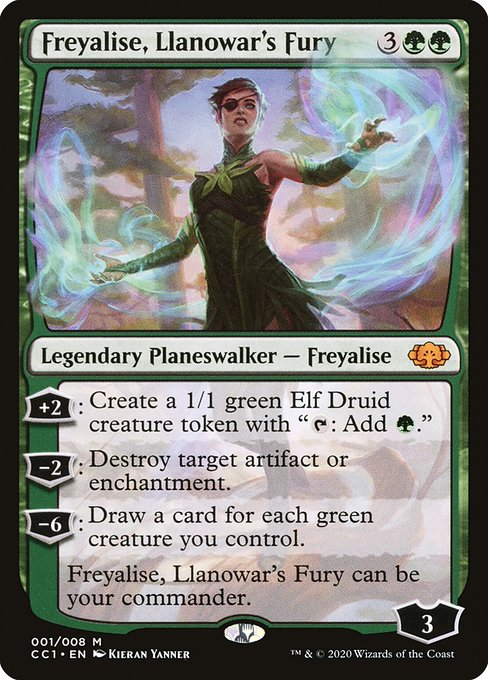
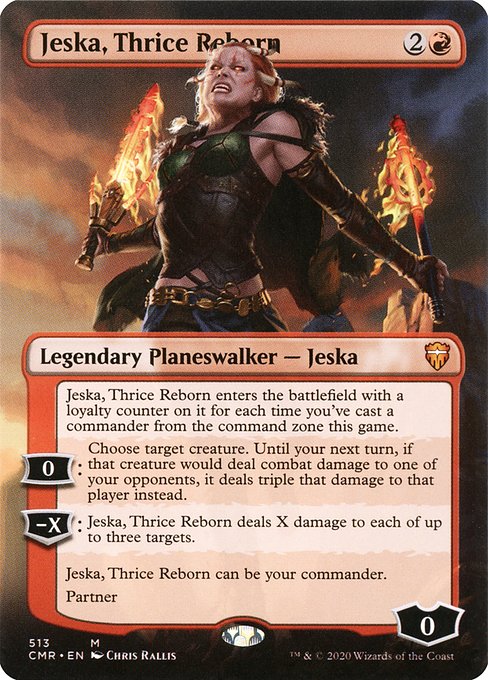
As opposed to creatures, Planeswalker cards represent an ally with similar abilities to you, the player. You can activate your Planeswalker’s powerful loyalty abilities once each turn. Their Loyalty counters represent their health, and your opponents can attack them. Planeswalkers generate value every turn, so if your commander is one, you’ll want to play it as soon as possible. If it costs four or more mana, you might want to consider mana rocks like Arcane Signet.
If your commander is a Planeswalker, you’ll also want to be able to protect it. You’ll need to play creatures to block with, preferably with keywords like reach or flying to block your opponents’ fliers. Even then, they’ll be tough to protect. In a one-on-one game, you only have to protect your Planeswalkers from one player, where in EDH you’ll have three opponents trying to attack your commander. Boardwipes like Wrath of God and Blasphemous Act can also protect your commander by removing potential attackers.
Planeswalkers do have some advantage over traditional commanders. Firstly, Planeswalkers are stronger against removal spells. Most single-target removal that people play is focused on creatures. If you’ve got enough blockers, it can be very difficult for your opponents to remove your commander. Often, their abilities will help you protect them by creating blockers or will help you remove opposing threats.
Perhaps the greatest strength of a Planeswalker is that Planeswalkers have multiple abilities, only one of which can be activated per turn, meaning they frequently have both a setup and a payoff ability. Simply by keeping a Planeswalker you control alive for a turn cycle, you can often execute an entire gameplan off of one card. Oko, Thief of Crowns is an infamously broken example of this (thankfully he is not allowed as a commander). You can activate his +2 ability to create a Food token the turn he comes down and than activate his -4 to swap that Food for your opponent’s 3-drop.
While few Planeswalkers that are allowed as Commanders dare to match Oko, many of them have their own synergies between their plus and minus abilities. One ability might make an artifact token, while the other discounts your next spell for each artifact you control. Another commander might have a lifegain ability, while the other ability spends life for some powerful payoff.
So what are some ways to build Planeswalker commanders?
Like a spell, but better!
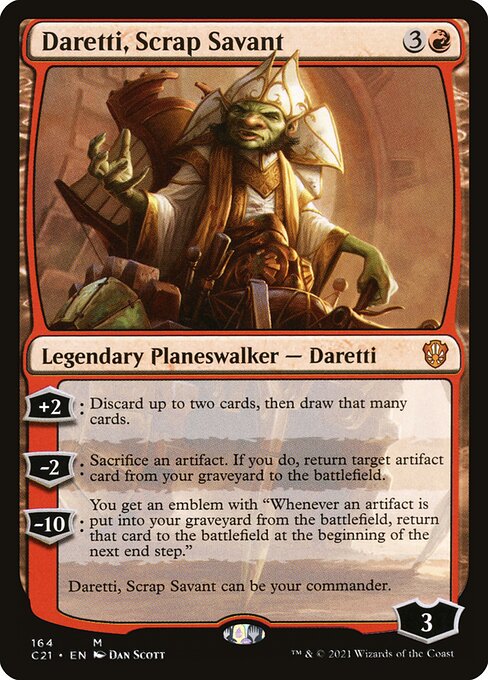
Daretti, Scrap Savant’s -2 ability is the star of the show on this commander, letting you reanimate an artifact from your graveyard. His +2 lets you draw 2 and discard 2 to set up your graveyard for that reanimation. You’ll want to make artifacts, dig through your deck, and play a bunch of big, splashy artifacts to reanimate.
In this kind of deck, Daretti functions like a Trash for Treasure in your command zone. In every game, you’ll have the ability to pay four mana to sacrifice an artifact and reanimate another artifact, and you get the Planeswalker as an extra bonus. It’s always exhilirating to get a big artifact like a Portal to Phyrexia or a Cityscape Leveler out on turn 4.
Keeping Daretti on the board is beneficial because of the synergy between his plus and minus abilities. You can discard your big artifact to draw more cards, then have enough loyalty to bring that artifact back on your next turn. At the same time, Daretti doesn’t need to survive to fulfill its purpose. Some of this deck’s payoffs and enablers can generate blockers, like Myr Battlesphere, Threefold Thunderhulk, and Loyal Apprentice, but it also runs plenty of draw/discard effects to dig out and dump your best payoffs without Daretti’s plus ability. Unless there aren’t any creatures on the board, you should only play Daretti when you can immediately reanimate a powerful artifact.
This strategy is perhaps the easiest way to build a Planeswalker commander deck. Other strong options for this kind of deck include Dihada, Binder of Wills and Sivitri, Dragon Master. Dihada can help you play big Legendary Creatures, while Sivitri can tutor for dragons. Below is an example decklist I made for Daretti.
Creatures (26)
Instants (6)
Sorceries (7)
Artifacts (22)
Enchantments (1)
Lands (37)
101 Cards
$196.43
Fortress of Stompy
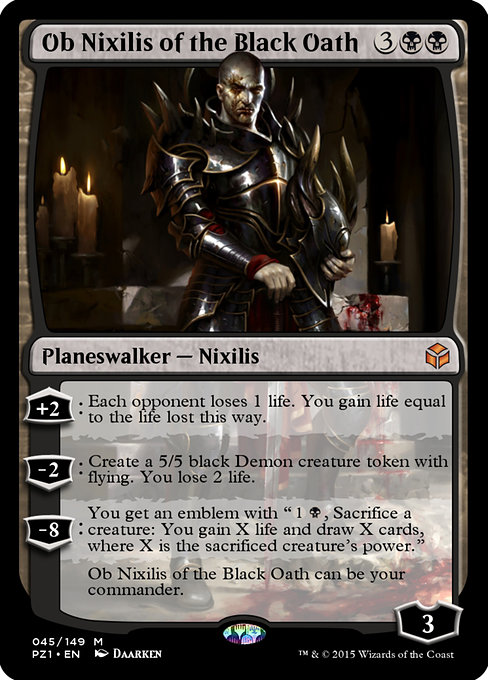
Ob Nixilis of the Black Oath is one of several Planeswalkers that have abilities that make tokens. He makes a 5/5 Demon token every other turn. This makes him much easier to protect. After your commander hits the field, you can dedicate the rest of your deck to typical midrange shenanigans. Prioritize draw spells and draw engines, big removal spells like Invoke Despair, mana doublers, and big win conditions like Valgavoth, Terror Eater and Torment of Hailfire.
While ‘wider’ boards with more creatures probably won’t get past your Demon tokens without a few casualties, you should bring quality single-target removal to take care of unblockable creatures and creatures with the potential to overpower your big tokens. I like playing cheap targeted removal here. Cards like Soul Shatter are incredibly valuable in most decks (and certainly still worth including here if your build has the space), but in this deck we want to remove creatures early and while they’re small. For that, you can look to constructed staples like Fatal Push, Snuff Out, and Dismember.
You can also look for ways to make even more demons with Ob Nixilis. The proliferate keyword lets you put an extra counter on anything with a counter, including your commander’s loyalty. Staff of Compleation is a mana rock that can then proliferate for free every turn, or draw cards if you’d prefer. Contagion Engine can proliferate twice for four mana, which gets you a demon every turn while also putting -1/-1 counters on your opponents creatures (and those proliferate too!). Finally, Vraska, Betrayal's Sting is a Planeswalker who can proliferate as a loyalty ability. Your demon tokens will protect her, too.
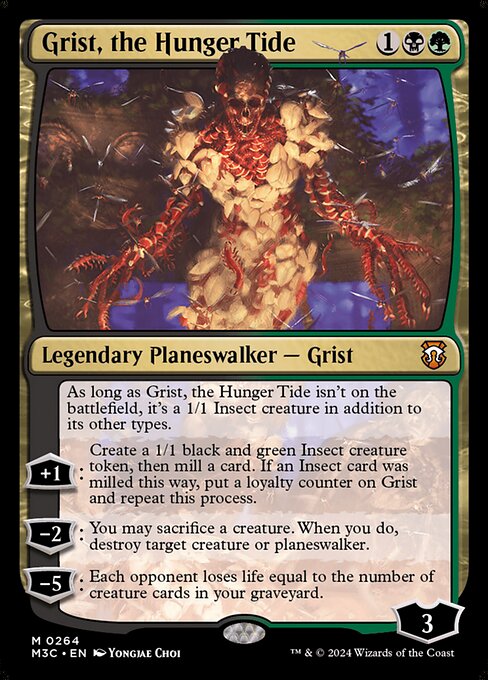
Elminster is another prime candidate for this deck style. He can make a pile of 1/1 fliers to protect himself alongside his scry-related abilities that power a strong gameplan. There aren’t any other Planeswalker commanders that create flying tokens immediately, but Grist, The Hunger Tide, Jared Carthalion, and
Planeswalkers (8)
Creatures (14)
Instants (15)
Sorceries (9)
Artifacts (12)
Enchantments (4)
Lands (39)
101 Cards
$418.19
Playing Superfriends
As we’ve established, Planeswalkers have certain needs that must be met if you want them to stay alive. Here’s a question: If you’re putting in the work to protect one Planeswalker, why not protect more? That’s the idea behind the ‘Superfriends’ strategy. The same suite of removal and board of blockers can protect all the Planeswalkers on your board. Unfortunately, not all of them can be commanders, so which Planeswalker commanders are the best for this strategy?
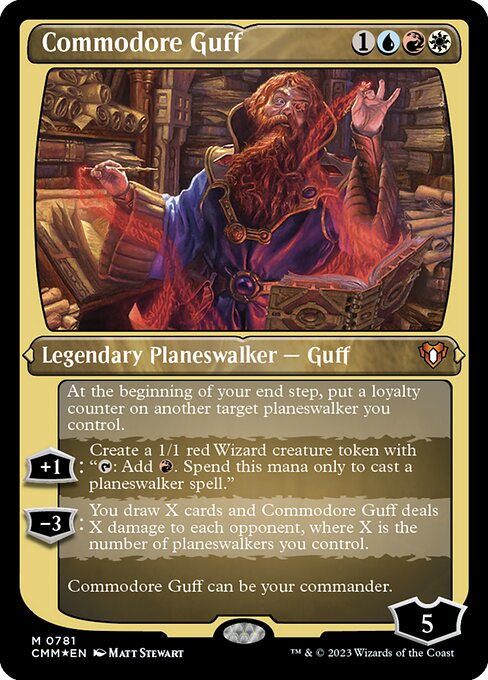
Commodore Guff is a card literally designed to head a Superfriends deck. His static ability gives your other Planeswalkers loyalty counters, his plus makes mana dorks that can only pay for Planeswalkers, and his minus draws you cards and hits your opponents for each Planeswalker you control. He’s also a 3-color commander, giving him access to over 150 different Planeswalkers for your deck.
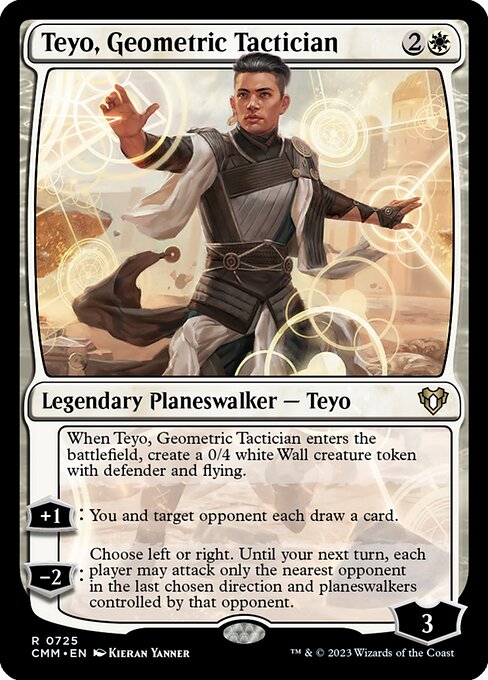
The first step of a Superfriends deck is the blockers. We play, as per usual, cheap flying blockers and cards that make them. Fog Bank, Ledger Shredder, and Mischevious Mystic can all be great at helping your Superfriends survive the early game. The Planeswalkers themselves should also help out. Dovin, Grand Arbiter, Kaito, Cunning Infiltrator, and Teyo, Geometric Tactician are all 3 mana Planeswalkers that make you more blockers on the turn they come down while providing additional benefits. I would aim for at least 15 Planeswalkers that can make creature tokens of some kind, and at least 8 that can block fliers.
Planeswalkers are great at interacting with the board in other ways too. Iconic format menaces like Chandra, Torch of Defiance,
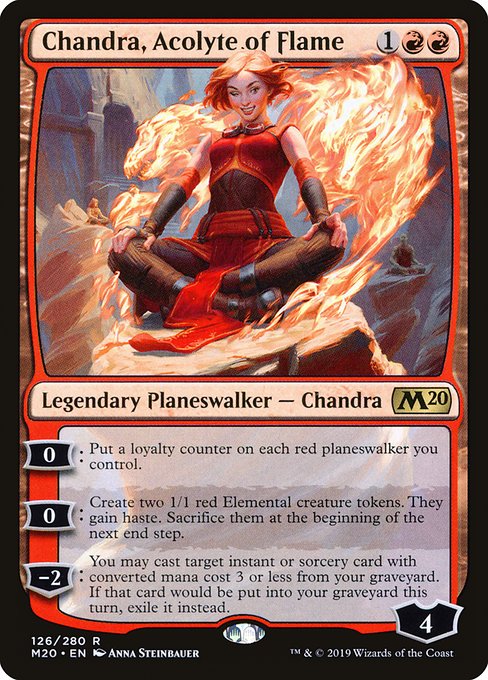
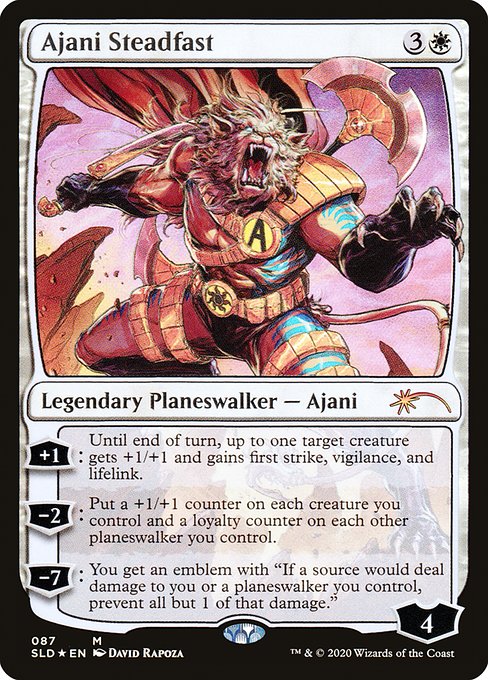
Oath of Gideon gives all your Planeswalkers an extra loyalty counter as they enter, and Oath of Teferi lets you use their abilities twice per turn. Chandra, Acolyte of Flame and Ajani Steadfast both have loyalty abilities that put loyalty counters on all of your Planeswalkers. And who could forget the Proliferate keyword? Ripples of Potential can phase out all of your Planeswalkers at instant speed while proliferating them, protecting them from an attack or a boardwipe that hits Planeswalkers, and Grateful Apparition and Thrummingbird are two mana flying creatures that proliferate when they hit a player.
Most Planeswalker commanders may not be as well-tuned to lead a Superfriends deck, but you have other options. Nicol Bolas, the Ravager comes out as a 4/4 flying blocker and transforms into an extremely powerful Planeswalker for seven mana, and in my opinion he is the best option if you want to build a Nicol Bolas-themed commander deck.
Here’s the decklist for Commodore Guff’s precon. You can probably find it at your local game store and it’s a full Superfriends experience right out of the box.
Planeswalkers (17)
Creatures (17)
Instants (5)
Sorceries (4)
Artifacts (15)
Lands (38)
99 Cards
$222.83
Sideboard
1 Cards
$22.99
What have we learned?
- Building deck for a Planeswalker commander comes with unique restrictions and strengths, and your commander choice can circumvent those weaknesses or amplify those strengths. Often, a Planeswalker’s different abilities form a cohesive gameplan all by itself, meaning you just have to protect it for a turn or two.
- While you can only use each Planeswalker’s loyalty abilities once per turn, there are many ways to give them extra loyalty counters in different colors. Keep an eye out for cards that Proliferate.
- Blockers are very important if you’re playing a Planeswalker commander. Typically, you should try to include cards that are or make big blockers to protect your commander. Boardwipes that don’t destroy Planeswalkers can also be very powerful. Your opponents can’t attack your Planeswalker if there aren’t any creatures left to attack it.
- Including lots of Planeswalkers in your deck can be very powerful if you’re already protecting your commander. In this type of ‘Superfriends’ deck, Planeswalkers that make blockers, remove opposing threats, or draw you cards can quickly snowball into a massive advantage for you.
That’s all for today. Enjoy your trip through the multiverse with your new Planeswalker commander.